Modifying a 1952 Chevy Truck. Original bodywork - modern upgrades.
www.1952ChevyTruck.com

1952 Chevy truck upgrades. August 2011 onwards

Wheels and Tyres. Return to menu page. Pages are long. Scroll down.


Part 8. August 2011. Wheels and tyres.

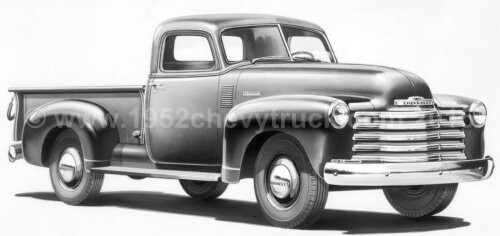
The original 1952 truck wheels and tyres -

This is all quite complicated and so a full page has been dedicated to the subject.
Most original 1947-53 "Advance Design" trucks would have had 16 inch wheels
(at 6 inches wide) and 4 ply tyres.
The total diameter of an original wheel and tyre would have been about 686mm
This has been estimated in two ways. Firstly the width of the original tyres was 6 inches and so
an estimate of the tyre height for that type of tyre would have been about 5 and 1/5 inches. This gives
16 inches + 5 and 1/5 inches + 5 and 1/5 inches = 27 inches or 685.8mm. Secondly if you look at extract
from the official GM table for the 3100 (1/2 ton) Advance Design truck, the rolling radius is
27 inches which again results in a diameter of 685.8mm. Here it has been rounded to 686mm
The table below shows a rolling radius of 13.5 inches which is 27 inches diameter
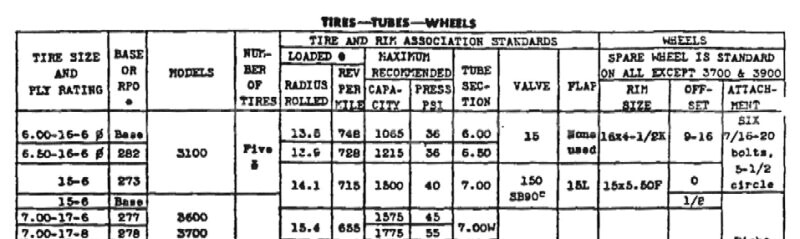
Chevy table

Whitewall tyres were not available prior to 1955. Four ply blackwall tyres were used.
The original 1952 wheels had 6 holes for the 6 studs.
A useful site specialising in original truck information is at
http://www.antiquechevytrucks.com/Content/Orginal%20Restoration/advancedesign_main.htm

Alloy wheels and radial tyres -

This particular truck had four 15 inch alloy wheels (at 7 inches wide) when purchased in the States and the
tyres fitted were 235/75/R15 which gave an overall diameter of 734mm. This diameter is larger
than the 686mm size of the original wheels and tyres. 2 years ago the front tyres were changed to 225/60/R15.
These tyres were therefore smaller at 651mm Dia. Indeed the front wheels were 83mm smaller (in diameter) than
the back at 735mm. This was done to improve handling but the ride was poor. In addition, the truck was too low
at the front. The "stance" was also too aggressive. The front tyres never felt right and had a poor ride.
"Stance" refers to whether the truck is level from front to back, low at the back or low at the front.
Cars and trucks that are low at the back to not look good. Indeed this type of stance looks like the suspension
has failed or become soft as it might in an old vehicle that had not been cared for. Level looks fine
but usually higher at the back than the front i.e. an aggressive attitude or stance looks good (with reason).
To maintain the same diameter wheels at the back as the 235/75/R15 that came with the truck (at 734mm)
it was decided to go with new 16-inch wheels and 235/70/R16 tyres. This provides a total diameter of 735mm.
Only 1mm different than the original alloy 15 inch wheels and tyres that came with the truck. (The 235/75/R15s
were probably fitted in it's original "restoration" in the States in 1998. I have the word "restoration" in
inverted commas as it is very clear there were many things wrong with the truck that have needed rectification
since we started work on it.) Anyway 735mm looked right on the back and these large tyres had comfortable ride.
Since 16 inch wheels look better than 15 inch and larger wheels on the back compared to the front (within reason)
also look better, 16 inch wheels at 8 inches wide were chosen for the back.
It was, however, decided to use 15 inch wheels on the front and 235/70/R15 tyres. This gives a final wheel diameter
of 696mm. That makes a difference of 39mm in diameter (or about 1.5 inches - 3/4 of an inch in radius) compared to
the rear wheels at 735mm. This is a noticeable but not massive difference in size. Along with other suspension
factors the truck will still have an aggressive but not excessive stance. All new rims will be 8 inches wide.
Comparing the original 1952 wheels with the new wheels shows the front to be similar - 695mm is similar to 686mm and
on the rear the difference is larger with the new wheels at 735mm compared to 686mm - 49mm larger (about 2").

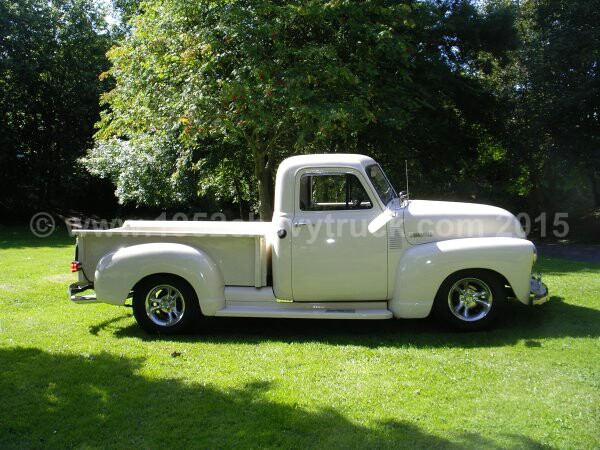
The picture below shows the truck in July 2011 with the 15 inch "Pacer" alloy rims. As you can see the front
tyres are too small and the truck is too low at the front.

July 2011 truck

Lower down the page you will see the theory notes on wheels and tyres. These notes show the relationship between
rim diameter, rim width, how to measure stud / lug spacing, offset angles and backspace. They detail the
relationship between rim width and tread width (e.g. "8-inches" and "235" from a 235/70/16 tyre). Offset,
backspace and whether the correct amount of either can increase the "track" of a vehicle using negative offset.
How wider wheels can also be used without affecting the track significantly with positive offset. Also explained
is how larger wheels can reduce gearing which in turn reduces engine noise and increases fuel consumption.
There is a great deal to this interesting subject.

Here we intend to be truck specific and so the background theory below should be read and referred to if a full
understanding is to be appreciated on how all of this theory has been interpreted for best results on this truck.

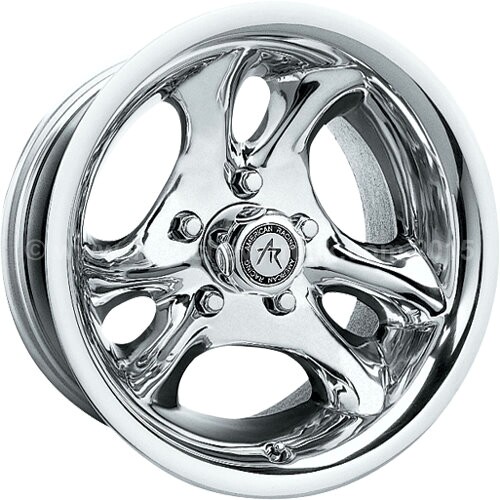
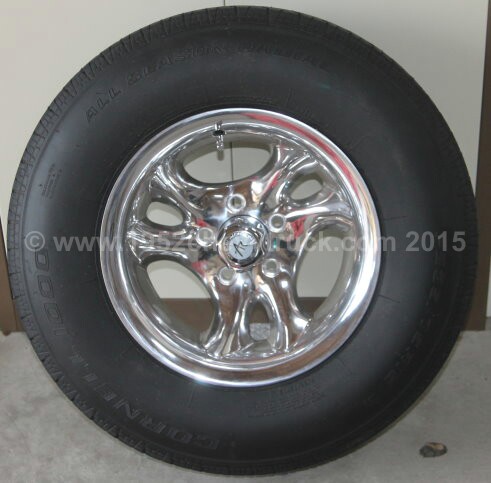
The wheels chosen for this truck are the American Racing Ventura wheels. These are the same as the alloy wheels
that came with the truck from the States (from the 1998 Stateside "restoration") except for the centre cap. The
wheels on the truck were "Pacer" and the centre cap will now say "American Racing" instead. It is possible that
"American Racing" bought the design at some point in the last 10 years as they now seem to be only available
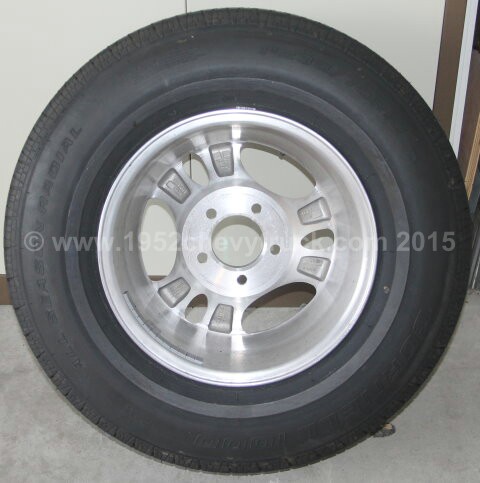
from American Racing. The original alloy wheels (I am using the words "alloy wheels" to describe the "Pacer"
wheels from the 1998 "restoration" in the States so as not to be confused with original Chevy 1952 steel wheels)
and these alloy wheels were 15-inch by 7 inches wide as stated. Remember the new wheels are 16s on the back,
15s on the front and all 8 inches wide.

See American Racing Polished Wheels

American Racing Ventura

Finding a supplier -

The American Racing wheels were purchased from www.4wheelparts.com
This company is not always the cheapest for parts but they are competitive and are usually close to the
cheapest. 4wheelparts do, however, ship internationally at very competitive rates.
If you can find a company that will ship internationally (without going through an expensive forwarding agent)
it is likely there will only be expensive courier options like UPS or FedEx and typically the price of shipping
4 rims to the UK will be about $750. 4wheelparts tend to use the insured US mail postal service and this is usually
passed on to Parcelforce once it enters the UK. This type of delivery will probably cost only about 25% of the
other options. e.g. If a delivery is to cost $800, the US mail option will be about $200. This makes 4wheelparts
the cheapest way by far to buy rims (and other items) with international shipping from the USA.
It is also worth checking out other products with them as even if they do not have it on their site, they
will order an item in, if it is a company they deal with. Strangely these rims arrived from
4wheelparts using UPS and the shipping costs were no still higher ?? !!

Choosing the right wheels for this truck -

Let us now consider offset angles. The original alloy wheels has zero offset and the backspace was 3.75 inches.
That meant the plate that is offered up to the hub or stub axle is in the centre of the wheel.
(See theory notes below and the rim cross sectional diagram). These original alloy 15 inch wheels at
7 inches wide gave the truck a fairly narrow track at the front. This was mainly a product of the
Mustang II suspension which does tend to have a narrow track (e.g. compared to trucks that
use Camero front clip suspension.) By using a new 15 inch wheel at 8 inches wide with an offset angle
of -19 and backspace of 3.75 inches a wider track is achieved. To explain what this means consider
the new wheels backplate to be in the same position as with the previous wheels, since the new wheel
is an inch wider at 8 inches, all of that extra inch is pushed outwards. The wheel has a deeper "dish"
and the track is widened. It would be difficult to widen the track on an already installed suspension
and so using a wider wheel with negative offset deepens the dish and pushes the wheel outwards. A wider
track both improves handling and looks better. Again wheels that are a long way inside the wheel arches
also look like older vehicles. Modern cars and trucks have the wheels right up the edge or the arches.
To summarise an aggressive stance with larger weeks at the back and the wheels showing a wider track
looks better on a hotrod with bodywork close to 1952 specification. This would be described as
a mild hotrod upgrade rather than a radical one.
At the back the 16 inch wheels were also 8 inches but here the offset was zero. This pushes the extra
inch inboard. The track at the back was already wide enough and did not need to be increased. Wider wheels
look better but there is the possibility that the tyre might rub against the side of the bed.
A wheel spacer may be needed and this will push the wheel outwards a small amount.
The other option is to put wheel arches inside the bed by chopping up the sides of the bed.
This would take the truck too much away from original spec. and the inside of the bed would
not look as good. It would be too radical for this project.
It should be noted that a 19 degree negative offset was only available in this type of wheel in 15 inches
not 16 inches diameter (at 16 inches only zero offset was available) and so having the extra inch inboard
was something that could not be avoided anyway. This was also a reason why 15 inch wheels were chosen
for the front as here the extra inch could be outboard thus increasing the track where it was needed.

Choosing the right tyre -

There are many factors that affect tyre choice. They are listed below.
1. Speed rating.
2. Load rating
3. Dry performance
4. Wet performance
5. Low road noise
6. Comfort - good ride.
7. Appearance.
8. Cost.
9. Tyre reviews
10. Availability.
Remember, ideally the same type of tyre was needed for the front and the back. Tyre manufacturers do not make
all sizes and so a tyre was needed for the front and the back that was the same type.
235/70R16s on the back and 225/70/R15s on the front were required.

The tyre chosen was the FEDERAL COURAGIA S/U 109H
This is what the manufacturer says -

FEDERAL COURAGIA S/U 109H FEDERAL COURAGIA S/U 109H

High performance “H” and “V” rated tire for on-road performance that delivers a comfortable ride for
everyday driving. All season performance. The low profile Couragia delivers on street style combined
with a wild, aggressive attitude. The utmost statement of style. Stylish tread pattern and design delivers
ultimate traction, high performance grip, uniform wear rate, and all weather handling. Wide V-shaped
grooves increase water dispersion capabilities and prevent aquaplaning. Designed predominantly for
on-road use, the Couragia delivers high-speed comfort, low noise levels and quick steering
response for your favorite SUV and/or pick-up.

Features -

1. New SRG (Sloped Radius Gradient) tread pattern for outstanding wet performance, namely wet handling,
and prevents uneven wear
2. Unique complex sipes for ultimate comfort at all speeds
3. Extra hard carbon black in rubber compound reduces tire flexion – increases comfort when cornering
4. Large shoulder blocks engineered for tighter grip when cornering, improved handling capability
and enhanced steering response
5. High tensile bead wire and high bead filler maximize tire stability, safety and high speed reliability
6. Rim Protector provides extra protection for rims from curbs and potholes
7. High Turn-Up Polyester Casing keeps tire in proper dimensions and significantly enhances
safety during heat build-up

Tyre reviews -

Independent tyre reviews confirm the claims on wet and dry performance, comfort and low noise levels.
see Federal Couragia S/U tyre reviews

Cost and supplier -

The cost of these tyres is very reasonable. Typically about £65 (about $97) for the 225/70/R15 and about
£75 (about $112) for the 235/70/R16 including VAT and shipping. These tyres were purchased from "Click on Tyres".
Website http://www.clickontyres.com
see the 253/70/R16 at http://www.clickontyres.com/Federal/235_70_R16__FEDERAL_COURAGIA__SU__106H
and the 225/70/R15 at http://www.clickontyres.com/Federal/225_70_R15__FEDERAL_COURAGIA_SU__100H
To summarise, a quiet, comfortable, attractive high speed tyre with good wet and dry grip at a reasonable price.
As for mileage and wear, with a classic vehicle this is not a parameter that is of any significant interest.
Indeed long lasting tyres like van tyres tend not to perform well as the rubber is very hard. Not a
consideration here, however, there is no reason to believe the miliage characteristcs are not reasonable.

Attractive wheel nuts -

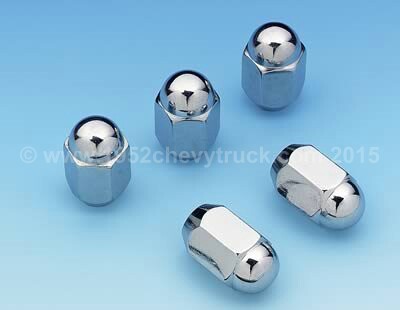
Finally it is worth mentioning the nuts that hold the wheel onto the truck. Attractive nuts from
"Mr Gasket" were chosen. These are available from Summit Racing (http://www.summitracing.com/parts/MRG-1440/)
manufacturers part number - 1440 and Summit part number - MRG-1440 Price $39.80 for 5 sets. i.e. 20 nuts
When fitting these wheel nuts a thin walled socket is required so that it sinks into the holes and gets a good grip
on the nuts. Make sure order the correct size of nuts for your studs used on your vehicle.

wheel nuts

Our own testing -

The new rims and tyres have not yet been fitted to the truck but this work should take place in the last
week in August 2011. A full test report will be included here.

The theory of wheels and tyres -

Introduction.

Choosing new wheels and tyres for your car is quite a complicated subject. This information
may be helpful. Rims have a number of specifications that need to be checked out - lug spacing,
diameter, width and offset / back spacing.
Tyre data to check out - tyre width, tyre profile, rim size, Performance and load rating.
It is also important to know out the final rim and tyre dimensions to make sure the tyre size fits the
rim of interest and also to check out the final diameter of rim with tyre fitted. Lug sizes vary with
manufacturer and there can be different lug separations even within a manufacturer.
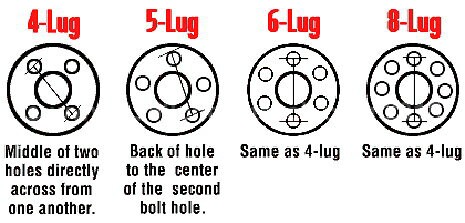
For example - the 1952 Chevy truck uses a 5-lug Chevy lug pattern that is 4.75 inches.
See below for how that is measured.

lugs

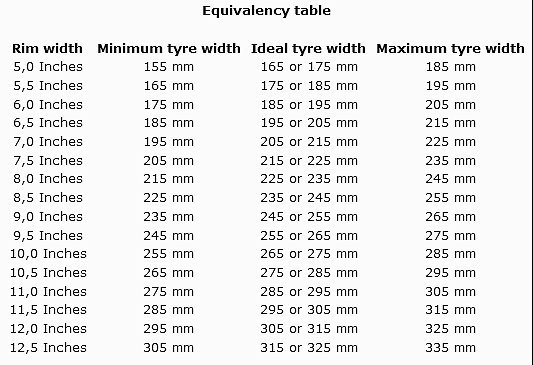
When deciding the diameter and width of the rim, it is important to check out what tyre will fit that rim
and what width and profile (see below) should be chosen for a particular final diameter and width.
This can be checked out using the table at http://www.etyres.co.uk/tyre-size-calculator.htm

tyre table

rims

Offset -

The offset (an angle) and back spacing (called "Rear Spacing" in diagram above) are also important. This
details the distance from your hub (stub axle) to the back face of the rim where the studs go through.
(Note. Back spacing is measured in mm or inches) A zero offset means the face is in the centre of
the width of the wheel. If the offset is positive, that means the back spacing is large.
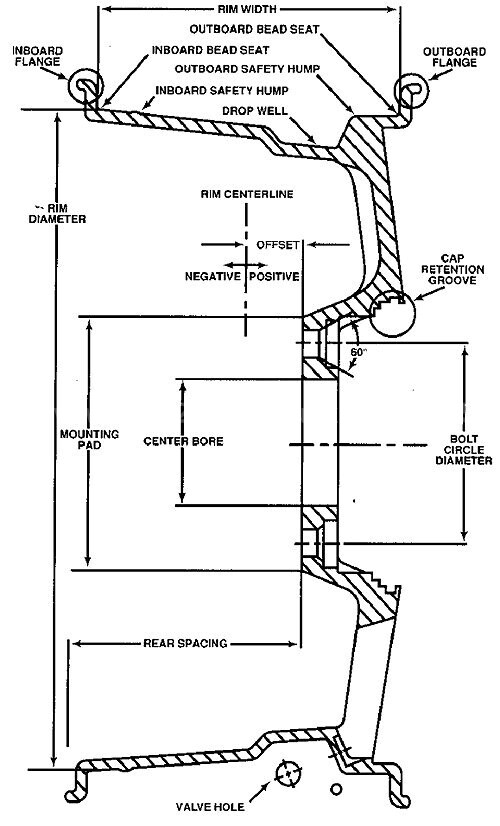
Here the outside of the wheels have only a slight “dish” and the most of the width of the wheel
is inboard. If the offset is negative, this means that the back spacing is small, the wheels have a deep
dish and most of the wheel is outboard providing a wider track. It is important to check the clearance when
wider rims and tyres are to be fitted so that the wheels do not foul either side of the inside of the inner
or outer wings or quarter panels. The web site detailed above show the relationship between large and small
profiles, widths and rim diameters and provide a total wheel with tyre diameter. Comparisons can also be
made between two wheels. When deciding the final diameter of the rear wheels, providing there is room under
the wheel arches, it is possible to increase the diameter. This has two effects. It reduces the gear ratio
and so the car revs lower at high speeds and fuel consumption also may be improved especially if an old
3 speed box (without overdrive) is fitted. However, it does makes the speedometer read slow. Not a major
issue if a satnav is used which includes an accurate speed readout. The final size of the front wheels
must be checked to make sure they don’t foul anything. This is done by moving the steering from lock to
lock. It is possible that larger diameter wheels on the back and smaller on the front can provide best
results. This is usually the case on modified vehicles and hotrods. Wider wheels on the back and
narrower on the front can also provide good results (within reason - if too wide on normal roads
handling and road holding may be worse.)

Tyre information -

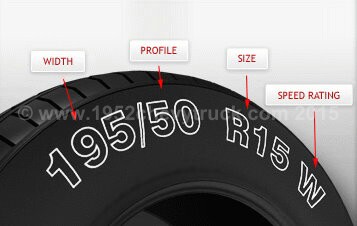
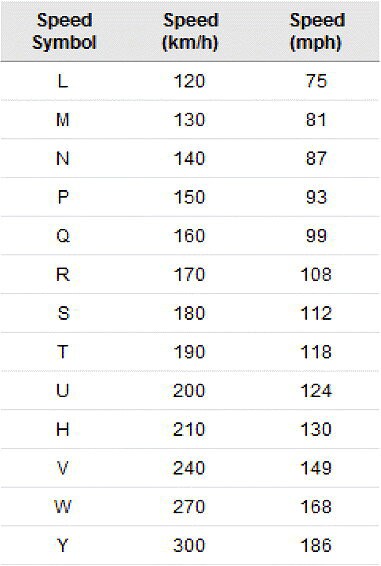
tyre sizes explained tyre speed ratings

195 is the tyre section width in mm (width of the tyre tread.)
50 is the profile or aspect ratio. That is the height of the sidewall divided by the tyre’s width.
(e.g. “high or low profile”)
R denotes the tyres construction. Here - radial.
15 is the rim diameter in inches
W is the speed rating.

When considering the performance of the tyre, comparisons are needed with other tyres by considering wet
and dry road holding, speed ratings, ride, noise and handling. It is usually best to consider the profile
and width of the tyre to achieve a good compromise between ride, comfort and handling. High profile tyres
are usually best for a comfortable ride. Low profile tyres are best for good handling. As a rough guide,
65 and above tends to offer the best ride and 60 and below offer the best handling. Noise is a product of
the tread pattern and here it is important to research the manufacturer’s data and tyre reviews online.
Indeed, all aspects of a tyre’s performance are best researched online using tyre review web sites.
Finally be sure to check the max. load of the tyre to suit your vehicle. It may be sufficient to see
“car tyres”, “van tyres” or "SUV / light truck tyres" but the dealers notes online will include information.
There is also a load rating stamped on the tyre’s sidewall.
Note- when changing either the rims or the tyres (e.g. snow tyres) from your vehicles original specification
your insurance company should be informed.

checking castor, camber and tracking.

It is important to set these parameters up correctly if the tyre wear is to be even
and if the handling of the vehicle is to optimised.

Two instruments are required to set these parameters.
1. A castor/camber gauge.
2. A tracking gauge.
Without these gauges it is possible to set the camber to a zero setting with a large right angle square against
the side of the wheel and with a tape measure to set the tracking. If these parameters are known to be out
by a large amount, the square and tape measure will result in adjustments in the right ball park.

The instruments are not, these days, expensive and will soon pay for themselves.
The Trackace laser alignment gauge is only £80.00 (about $120) see http://www.trackace.co.uk

Trackace


This was the instrument used on this truck. There is a very good instruction video on the Trackace
website. It takes only 2 minutes to set up and use this instrument. If the tracking then needs
adjusting, this may take 3 or 4 minutes, then another 2 minutes to recheck. Three adjustments were
needed to set up the tracking on the truck and so to both check and set up the tracking took about
15 minutes. Tracking should be towed in about 3 mm. The truck was set to a 3mm tow-in.
A small amount of toe-in makes rear drive vehicles more stable. (Tow-out tends to be unstable.)
While driving, dynamic forces will cause a little tow-out to occur and so a small amount
of tow-in will correct that problem, thus keeping the wheels parallel. 3mm or 1/8th of an inch is
recommended. Tracking is measured in degrees when using a tracking gauge but this can be converted
to mm or inches using the chart at http://www.trackace.co.uk/Manual/Conversion%20Chart.pdf

Camber can either be set at zero or a little negative camber can be applied.
For best traction and breaking in a straight line a zero camber is best. For cornering, a little negative camber
(You have negative camber when the top of the wheel is tilted toward the center of the vehicle)
is best as the wheel is then pushing it's width against the corner.
For most street cars, anywhere from 0 to 1 degree negative camber works fine.
A Formula 1 racing car has about 4.5 degrees of negative camber.
Too much negative camber can, however, produce uneven tyre wear.
It is probably best to set the camber to zero as the majority of driving will be on motorways.

Setting the correct castor on you vehicle / hotrod is essential for driving a steering stability.

First the technical description – the plane of rotation of the suspension (through the top and bottom
ball joints) compared to a vertical line through the centre of the wheel can be altered to provide
negative (-) positive (+) or zero castor angles.

Now the easy description – when thinking of castor, think of “caster wheels on a supermarket trolley”.
The wheels rotate at a point behind the pivot (oops getting technical again). If they are pointing
forward, as soon as you push the trolley, the castors swivel round and we then have “trailing casters”
(or “castor trail”). This is their nature stable mode of operation. They have “+ castor”. If pointing
forward they would have “– castor”
If the suspension on your car, truck or hotrod has “– castor” it is like the castors on the supermarket
trolley pointing forwards. When moving forwards, your wheels can’t turn through 180 degrees like the
castors on a shopping cart as they are tied together by the steering rack (and other things
e.g. sway bar etc.) BUT THEY ARE TRYING TO TURN BACKWARDS! The steering feels unstable, you need to
have a tight grip on the steering wheel, you have to concentrate more, as the vehicle moves forward
and hits bump in the road or the steering is turned, the wheels are trying to turn backwards.
With + caster, the steering is stable and the suspension geometry has a trailing castor angle. The
steering is in it’s natural mode of dynamic balance … oops technical words again … but hopefully
by now you have the idea. About 4 degrees of “+ castor” is fine. Some people recommend, 5, 6, 7, 8 or
even 9 degrees of “+ castor” but 4 degrees is a good starting point and is probably an average stock
value that car manufacturer would use. After that is a matter of experimentation.
The instruments you need to measure castor, camber and tracking and the methods showing how to
make the adjustments are all detailed below.

Measuring the “castor” angle.

We used an "INTERCOMP DIGITAL CASTER CAMBER GAUGE WITH MAGNETIC ADAPTER" at $339.00

Intercomp Castor Camber Gauge

See the Intercomp gauge at
www.intercomp-racing.com/Products/DIGITAL_CASTER_CAMBER_GAUGE_WITH_MAGNETIC_ADAPTER_805.cfm

Caster is best set by comparing with stock castor angles on new cars that have not ever been tampered
with. A typical stock castor angle would be 4.2 degrees. Anything from 4 to 6 degrees would be the norm.
Using the gauge why not try two or three cars that are new and see what the stock angles are?

Another good site showing castor, camber and tracking is at -
http://www.aa1car.com/library/wheel_alignment.htm

Read more at -
http://www.rodandcustommagazine.com/techarticles/135_0401_independent_front_suspension/index.html

In particular check out the captions and notes in the link above showing how + castor is a form of "castor trail"
or "trailing castor" as you move forward (like the castors on a shopping cart) and this gives stability. With - castor
you have to concentrate harder on holding the steering wheel, with + castor the steering wheel feels more stable.

To check castor angles it is necessary to rotate the steering 20 degrees to the right and 20 degrees to the left
while setting up the gauge to provide a castor measurement. It is important to be able to turn the wheels each way
by that amount. No doubt there are special wheel turntables to do this but we simply made a triangle out of a
large piece of cardboard with an angle of 20 degrees cut out and then used one of these inexpensive lasers (that
are part of a spirit level) projected onto a cardboard screen set along the front bumper so that when the wheel was
turned, the laser beam would hit a mark to show 20 degrees of turn had been achieved. See pictures below.
There was a centre mark (vertical line) and another to the left and to the right on the card. Using trigonometry the
angle was double checked. 78cm from centre of wheel to screen. 29cm from centre mark on the cardboard screen
to either the left or right hand marks. The inverse "Tan" of 29/78 is 20.39 degrees. Pretty close!

Using a castor camber gauge Using a castor camber gauge

Using a castor camber gauge Using a castor camber gauge

How to adjust camber and castor on a Mustang II suspension.

This truck uses Mustang II tubular suspension (from Speedway Motors) but note Mustang II stock suspension is adjusted
in the same way. There are "turrets" (sometimes called "hats" or "top hats") welded to the Chassis (Frame).
These turrets have slots (that run transversely across the vehicle) and the upper suspension arm bolts into these
slots. The slots run across the turrets perpendicular to the frame rails (chassis rails). It is therefore easy to see how
camber can be adjusted. If the upper suspension arm is adjusted to the end of the slots ... inboard, the top of the wheel
will tilt inwards and there will be - camber. If bolted at the end of the slots outboard (furthest away from the frame
(chassis rails), the top of wheels will be tilted outwards giving + camber. At some point towards the middle of the slots
(probably both slots equally) zero camber will be achieved. The best method of making adjustments is to loosen the nuts
under the turret only slightly so that, with a lever, the upper suspension arm can be slid inboard or outboard but
the arm still grips the turret enough not to slide (the tendency is to slide inboard due the weight forcing it in.)
With the castor camber gauge in position as shown in the pictures above (using the magnets that hold it in position in
the centre of the hub) the lever can move the upper arm in the slots until the gauge reads zero.
(or whatever camber is required but zero would be recommended for best traction, breaking and even tyre wear.)
Moving the upper arm equally in the slots can achieve this zero camber setting.
(This is a good starting point but this may not give a good castor setting ... so read on ..)
To adjust castor, the plane of rotation of the turning movement between the upper and lower suspension ball joints
must be altered compared to the vertical, That is a mouthful!!! and is best explained by looking at the following two
pictures. The spring and shock absorber is fairly vertical and so we can use them as a vertical reference point.

When looking at the pictures below remember the sway bar is forward of the disc and the brake caliper is behind the disc
and so the front of the truck is towards the right.

Picture 1 below shows the right hand side of the truck with wheel removed. Here you can see the upper suspension arm ball joint
(rotation point) is forward of the spring/shocker. i.e. is forward or towards the front of the truck. This is - (negative) castor

right hand side shows negative castor

The second picture (below) is again a picture taken of the right hand side of the truck and here you can see the upper suspension
ball joint (point of rotation) is rearward of the spring/shocker. i.e. towards the back of the truck. This is + (positive) castor.
This is recommended

left hand side shows positive castor

Picture 1 shows 4.5 degrees of - castor.
The lower picture 2 (above) shows 4.5 degrees of + castor and would be the recommended adjustment.
To make this adjustment we go back to the slots (the slots do the castor and camber adjustments). To achieve
+ castor the bolt through the front slot must be more outboard than the bolt through the rear slot.
This results in a twisting action that makes the suspension's plane of rotation tilt backwards
(rearwards - towards the back of the truck), however, as soon as this is achieved, since the bolts through the slots have
been moved this upsets the camber and so both camber and castor must be continually checked with the Gauge.
When the bolts through the slots are in the correct positions the castor becomes +4.5 and the camber zero.
To achieve this it is "probable" that the bolts through the slots might be as follows ... the rearward bolt might be a
little inboard of the centre of the slot and the forward bolt (towards the front of the truck) may be a little outboard
of the centre of the slots. (This inboard and outboard refers to the direction across the truck). In our case we found that
with 4 degrees of + castor and zero camber the front bolt was more than a just a little outboard. It was almost at the end
of the slot outboard (away from the frame (chassis)). No doubt all vehicles will vary from what was found with this truck
but hopefully this example provides a guide or a rule of thumb to achieve a good set up.
It is both difficult to explain and to follow this procedure but when you actually do the checking with a gauge and
make the adjustments, it all becomes much more understandable and clear. A bit of practical practice is needed.

After the castor and camber were correctly adjusted, the tracking was set to a toe-in was of 3mm

Road Testing.

This was done on the 9th Sept 2011.
First consider what the truck's steering as like prior to the setting up of camber, castor and tracking.
Over the last year or so there has always been a show deadline and putting the truck back together for the next show
did not provide time for setting up the suspension. Since fitting the new tubular suspension, camber had been set
with a set square and tracking had been set with a tape measure. Castor had never been set up.
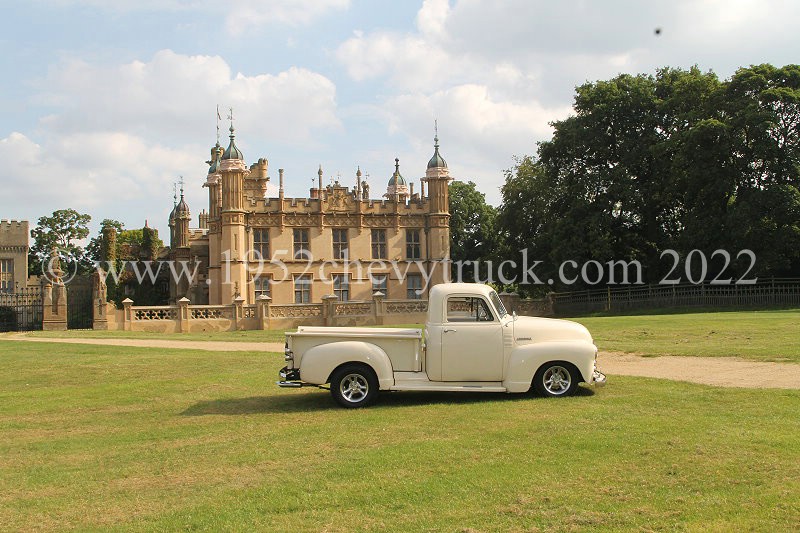
Before the last show at Nebworth Park, tracking had been set up with the new laser alignment system.
With the original mustang suspension, again the castor had never been set up but bump steer and
wandering had been eliminated. When driving to the Nebworth show it was necessary to hold the steering
wheel with both hands. You could hold it with one hand but two were better. Concentration was needed.
When the castor angles were checked, they were found to be -4.5 degrees on both sides. That is probably
due to setting up the slots equally when we now know the front slot should have the bolt pulled outboard
and the bolt in the rear slot needs to be pushed inboard.
After correctly setting up the castor to +4.5 degrees as detailed above with toe in at 3mm, this transformed
the drive-ability of the truck. With a modern car "one finger steering" is possible. That is to say little
concentration is needed to keep a modern vehicle driving in a straight line, at high speed, or any speed.
First impressions while driving to the main road were that the steering was returning to the centre after
cornering. Accelerating out of a corner and the steering was wanting to straighten. This was encouraging.
(Remember the wheels on a shopping trolley want to rotate backwards. With + castor a steering wheel wants
to return to centre and the front wheels want to point straight ahead.)
On the motorway speed was increased to 50mph and no real concentration was needed to hold the steering wheel.
It was not necessary to try the one finger test, with both hands off the wheel (not recommended) the truck
drove straight and true. Increasing speed to 70mph seemed to be even more stable. The steering just seemed
to want to continue in a straight line without driver input. It was possible to relax and know the truck
would be totally stable and predictable.

Conclusion.

This whole project has been a complete success and hopefully, if anyone out there is having problems,
this research, testing, modifying and adjusting to recommended parameters will provide the basis for
much improved drive-ability in many ongoing projects. IN particular these notes should help Mustang II
projects but the principles apply to all types of steering and suspension systems.
At this point in time the new wheels and tyres have still not yet been fitted!
That means there is scope for further improvements and there will be more testing soon.
Unfortunately one of the wheels arrived with a fault. It had some damage at the edge and a replacement is
on it's way. This has caused some delays but watch this space for more updates soon.

Note - UK spelling of "tire" is "tyre" and "center" is "centre". In the UK a "frame" is called a "chassis".
Curiously, with a monocoque constructed car (not body on chassis, note - "monocoque" is French for “Single Shell”),
in the UK we use the words - front or rear subframes. e.g. The front subframe of an original "Mini".


Link to our own satellite museum site

Rewind Museum. A Museum of vintage consumer electronics.
See

http://www.rewindmuseum.com/vintagesatellite.htm

Satcom 7700 satellite receiver.

For old Satellite receivers with knobs on! (and other historic items)
And
Vintage reel to reel video recorders. Vintage VHS and Betamax VCRs.
Vintage video cameras. Vintage Laser Disc. Vintage Computers.
Old telephones, Old brick mobile phones. Vintage Hi Fi, Old reel
to reel audio and early audio cassette decks. Including,
The history time line of vintage consumer electronics.
And much more .....
So see,


http://www.rewindmuseum.com/home.htm

Sony 2400 portable reel to reel video

It is well worth a visit.
Only The Satellite Superstore brings you great products,
advice and it's own MUSEUM


Rewind Museum


A Useful Search Engine.

bigdish

Google.
An excellent very comprehensive search engine. Find everything.
Probably the biggest search engine in the world.
www.google.com


Link to our main site. Satellite TV.

Sponsored by Vision International.
Note. One of our businesses, Vision International (established 1991) sponsors the
1952 Chevy truck site including financial support for this web site.
Vision International is one of a group of businesses that we have in the field of
Satellite TV. This is a link to our sponsor.

LyngBox LB-1 Definition 60cm Clear dish

tune in an extra 8000 channels? Watch the world? Links to some of the pages are below,

Sky Receivers Sky Accessories Transparent Dishes Motorised systems High Definition Receivers. Caravan satellite
Satellite receivers Catalogue index page of all satellite products. Technomate

This 1952 Chevy truck web site is maintained on a non-profit
making voluntary basis. Our main business website is at
www.satellitesuperstore.com/cat.htm
Our main business is satellite TV and we are a specialist satellite company.
We supply satellite goods in the UK and worldwide including fixed and
motorised satellite systems, accessories and installation equipment.


Web site copyright © 2011 Vision International. All rights reserved.
For all questions & comments about this site's content contact Dave using our
Contact form (We only accept questions in English. We do not open attachments.)