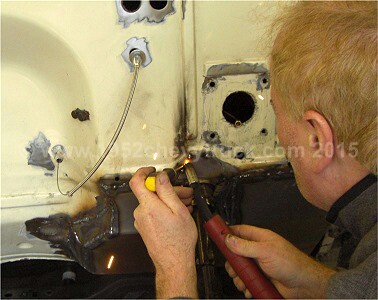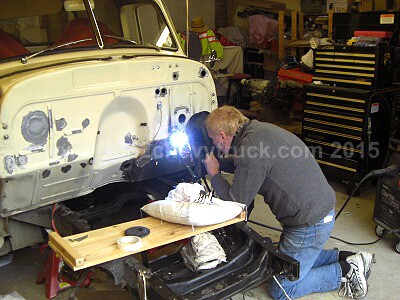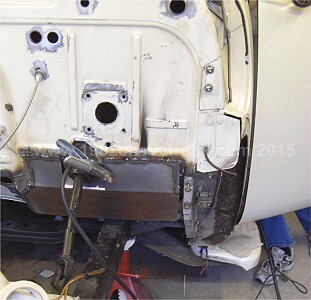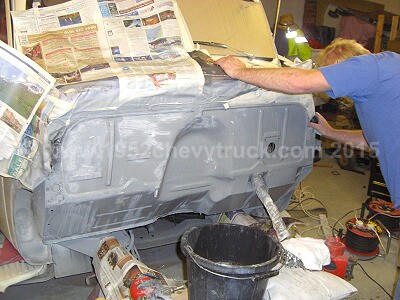
Front end strip down - both sides of the firewall

Sept 09 - The front end strip down has started.
The inner and outer wings (fenders) have, so far, never been removed until now.
Aims,
To improve further the front suspension.
Re-fit the radiator correctly. It had not been fitted correctly by the previous owner / 1998 build.
Improve appearance of top of radiator with some mods and paint it.
Correctly fit rubber radiator mounts. (They were missing!)
Remove old (poorly made) engine mounts and manufacturer new stronger mounts.
Left side - re-route the air con pipes so make a cleaner inner wing.
Right side - re-route wiring to make a cleaner inner wing.
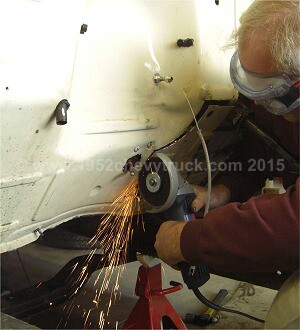
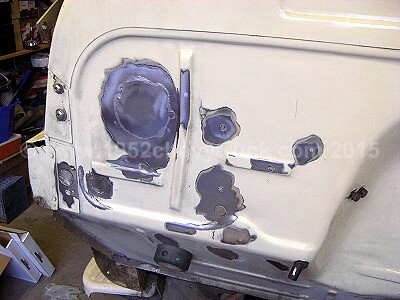
Repair and paint inner wings - Repair all areas where the "butchers" have cut them to fit the suspension.
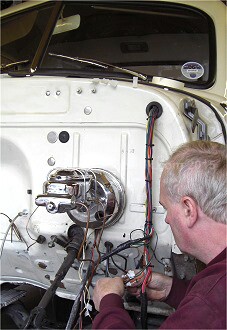
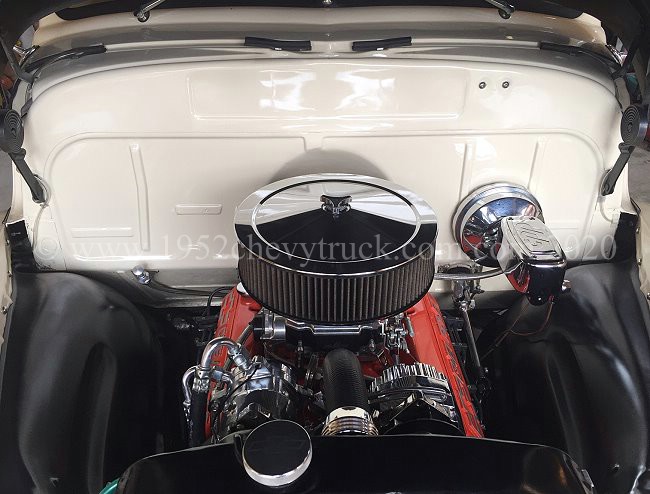
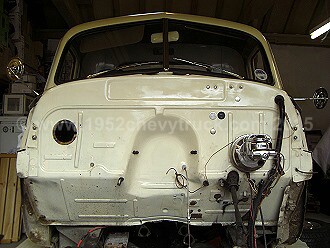
Firewall - re-route air con pipes and electrics to make a cleaner firewall.
Attend to all areas that need to be rebuilt properly and reduce rattles.
All parts to be re-fitted through Evo mastic and with stainless steel bolts.
Deadline - mid November for the British Classic Car Show at the NEC Birmingham UK.
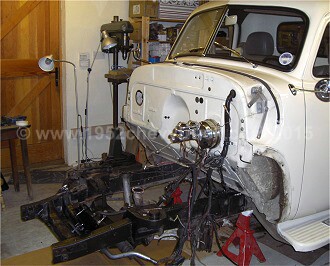
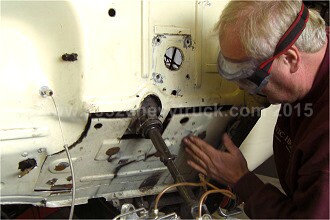
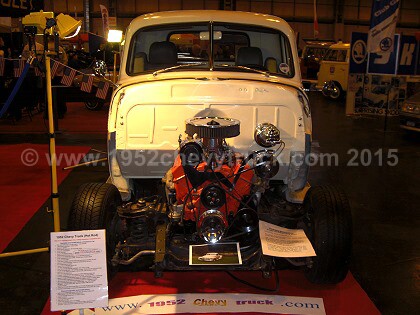
Untidy firewall. Holes and wiring.
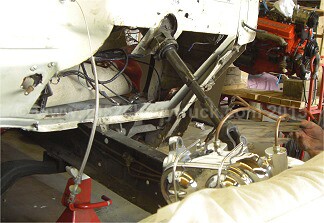
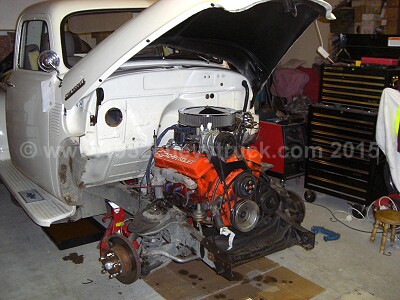
Engine and transmission removed. Sept 09.
The outer and inner wings (fenders) were removed, the bumper, front grill and radiator and the air conditioning
pipes. The lower and upper suspension arms were also removed ready for the new arms to be fitted.
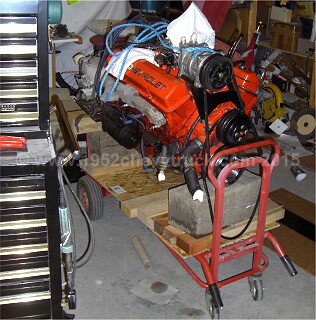
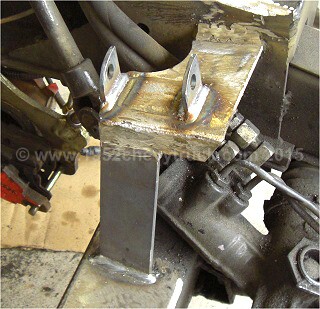
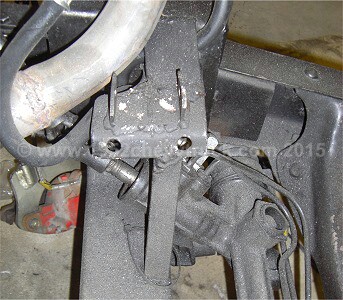
Improving the engine mounts. Oct 09
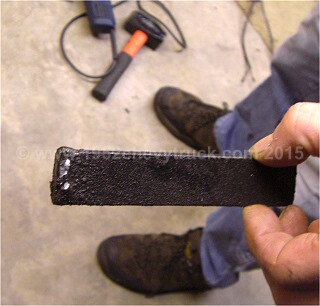
Notice the poor quality welds, the thin materials and from the right hand picture
Left hand mount below. Notice from the removed upright how much of the weld did not penetrate.
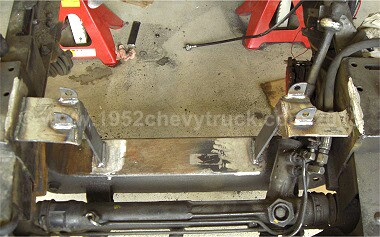
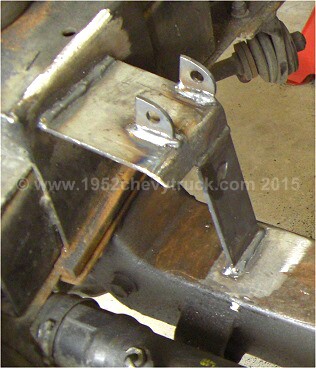
Below are the improved engine mounts.
Also compare above and below, the mounts are moved backwards a about 12mm.
This will provide a little more clearance between engine and radiator.
Untidy Wiring.
"Podding". Moving back the pedals to provide more leg room.
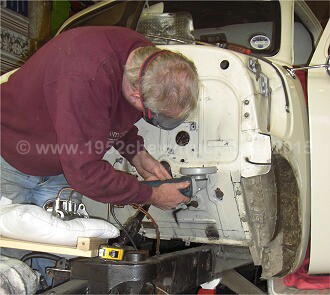
A great deal of effort was put into keeping the steering column as compact as possible
and using a steering wheel with a very shallow dish to provide more arm room and increase
the distance from the seat to the steering wheel.
Here we are providing and extra 50mm (2-inches) of leg room. This effectively extends the cab
for the driver. These trucks have a short cab and this will lead to a more comfortable
driving position. It will also be necessary to modify the left hand inner wing (fender).
to fit in with the "podding". Actually when the pedals are moved forwards it may be possible
to achieve an extra 3-inches but the left foot rest position will be 2-inches further back.
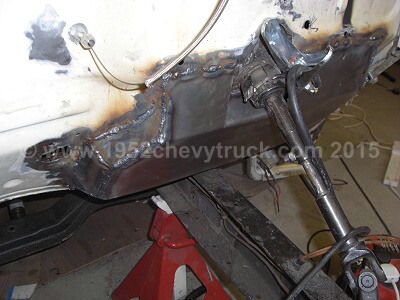
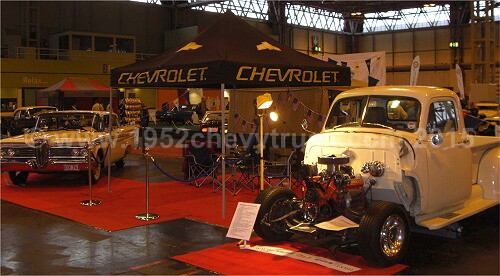
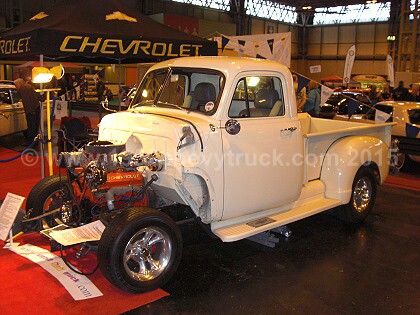
The British Classic Car Show. Nov 09. NEC.
Well ... we made it... firewall finished, podding finished, engine back in, temporarily put the old
suspension back on, set up the suspension and towed it using an A-Frame.
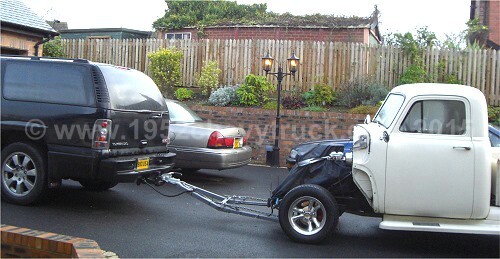
My GMC Yukon Denali XL was used to tow the truck the 205 miles to the National
Exhibition Centre (NEC) in Birmingham England.
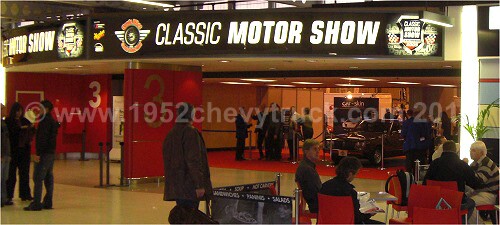
The photographs were taken on the Thursday set-up day as we knew that on Friday, Saturday and Sunday
the truck would be always surrounded by people. This was an understatement!
Part 7. Front end and Cab Restoration Continued
Jan 10 - end Feb 10. Repairing the inner wings. (Fenders)
After the NEC show we were into December and Christmas and so work started again in January. Parts needed to be
restored and put back onto the front end. The inner wings needed restoring and altering to suit the new
suspension that was to be fitted. The original Mustang 2 suspension had been fitted by the previous owner
and it can be seen in the pictures below that little care (understatement) had been taken in cutting out
the inner wings around the top suspension arm. The new tubular suspension arms would be even more compact and
so very time consuming fabrication work was need to both repair and remodel the inner wings. There
were also many holes left in these wings, some GM and some from past projects. They were all filled with
new metal. The strength of the inner wing was re-instated by folding the new metal along the bottom edge,
following the shape of the suspension turret joining up to the original GM folds. A small gap was left
between the inner wing and the chassis as these structures are not meant to be connected. It is planned
to add a rubber skirt along the bottom of the inner wing to stop any splash water from getting through
from the wheels to the engine bay.

After alteration and test fitting, the inner wings were media blasted and painted.
March 10 - April 10. Repairing the "A" pillars.
The bottom of the A pillars looked OK at first but after further inspection it was clear another "can of worms"
had been found (hopefully the last can!) New metal was needed for the bottom sections of the A pillar and more
new metal where they attached to the floor. As usual, 2-pack acid-etch primer was used, then primer and top coats.
Pictures are shown below of this work. Pictures are shown below of this work.
June - July 10. Front end preparation and re-assembly.
The A pillars were sprayed with Shultz to protect them in the water splash areas. All wiring was renewed
and routed through the chassis keeping the inner wings clean from wiring. The new tubular suspension was fitted.
This suspension did not have any provision for the anti sway bars. This did not make any sense. Why produce a
better suspension system and not include a method of fitting the front anti sway bar? We have always suspected that
some companies or enthusiasts are more interested in appearance than performance and this would tend to support that
view. A re-design was needed. The tubular arms were modified and additional parts were fitted so that the front
anti sway bar could be bolted on. This involved using some anti sway parts from a modern GM car and making
anchorages for them on the lower suspension arms. These new parts transferred the sway forces
from the suspension arms to and through the anti sway bar. See pictures below.
The painted inner wings were fitted. They were bolted on through Evo Mastic. The side of the inner
wings in the splash area (near the wheels) was sprayed with many layers of Shultz. The lower front panel
(with horns shown bolted to it) was media blasted and painted. A new heavy duty low noise electric fan was fitted.
This involved modifications to the radiator so that it would bolt on. The wiring to the alternator was improved.
The wiring from the fusebox in the cab now emerges just forward of the A pillar then runs downwards then in and
across to the chassis. A new accelerator was manufactured including the bearing that bolts to the firewall. The
top of the radiator was restored, and modified to improve appearance, then painted. Stainless steel bolts, both
hex and buttons, were used throughout the re-assembly. The outer wings, front sections and hood were bolted back on.
The outer wings and hood etc. were not to be restored and painted at this stage. They needed to be removed later
so that the new air conditioning pipes can be fitted and rerouted through areas that again will keep the inner
wings (fenders) and firewall free from clutter inside the engine bay. The (new) transmission oil cooler was
relocated behind the front bumper bar just forward of the cross member facing forwards in the air
flow. The horns were re-positioned below the oil cooler
11th July. Americana 2010.
The front end of the truck was re-assembled in time for the Americana show on the 11th July 2010
This did not include the re-assemby of the air conditioning pipes. New pipes had been purchased
and the plan was to re-route them through the right hand wing to keep the engine bay
as uncluttered as possible. Apart from that, the truck performed well on the motorway
with the modified tubular suspension. See below the picture from this show.
July - November 2010. Cab restoration 2.
Considerable work had already taken place previously in the cab. The re-inforced flat floor, the 10 way powered
seats and the sound deadening. "Dynamat extreme" had been applied on the underneath of the floor, the rear of
the cab behind the seats and on the floor up to the end of the seats. Now for the second stage - The front
windscreen was removed. The gauges, the heater, air con. box, the glove box etc were all stripped out of the
cab. The dash and the firewall were stripped to the metal and re-painted. The bare metal was acid etch primed,
primed and painted. Dynamat extreme was applied to the floor forward of the seats and right to the top of the
firewall, even including applying it upside down to areas at the top of the firewall. The sides around the
A pillars was also covered. Indeed almost all of the cab from rear window to dash was now covered, sound
insulated and sound deadened. It was decided not to re-fit the inside metal trim around the windows. Instead
demisting vents were manufactured into the curved dash. This resulted in an improved uncluttered dash.
Everything was re-assembled and finished just in time for the NEC show on the 12th November 2010 The pictures
below show the state of the truck 10 days before the show with the final top coat of paint going on 5 days
before the show. Once again it was down to the wire!
13th November 2010. British Classic Car Show. NEC 2010.
www.satellitesuperstore.com sponsored our stand.

Here you can see the dash was all put back together in time for the show.

Most pictures are taken before the public enter the halls but the picture below shows how busy it becomes.
Even in this picture it was a matter of waiting until the public are not in front of the truck.
Dec 2010 - Feb 2011. Another front end strip down through the winter.
Outer wings (fenders), front grill, and bumper removed.
Refurbished and improved air conditioning and heater with all pipes hidden.
Tubular suspension to be set up for best handling, castor, camber and tracking.
Front wings to be restored and painted.
New (triple plated) chrome front grill.

Since the firewall was now "clean" a new air con. kit was chosen as the drier in the new kit can be fitted to
the front of the condenser using the special pipes provided. Custom made steel brackets were designed and
fabricated to hold the condenser onto the radiator support frame. Again stainless steel bolts were used.
(The original drier had hung on the firewall).
Feb 2011. Quiet Mufflers (Silencers).

The front end strip down was interrupted for a couple of days to produce two new bolt on mufflers.
As shown previously, the design we have is a 3-part exhaust system using stainless steel flanges.
The same jig was used as per the previous mufflers. A local "laser profiling" company was used to
make the 4 flanges - £10 per flange (about $15 per flange). The mufflers are "Walker Quite-Flow 3"
units - part number - 22623 from Summit Racing at $74.95 each. Summit part number WLK-22623.
2.25" to 2" adapters were used as pipe spacer / adapters. These mufflers are ideal as they are
very compact (11" long) and have a low profile (3.25" high). They are designed as OEM equivalents
for an Oldsmobile Cutlas (1983-1987) with a 5.0L V8 engine. Clearly these are not "Hotrod"
performance "Flowmaster Hushpower" mufflers like the those already fitted, however, since this
flange system enables the mufflers to be changed over in about 20 minutes, this quiet set can
be fitted for the long distance high speed trips. With other modifications we hope to be
able to hear the radio at 70mph! Already fitted is a large amount of cab sound deadening
(although not including the doors as they have not yet been restored). We intend to removing
the rain gutter around the top of the door to reduce wind noise and eventually a 4-speed
automatic transmission (including an overdrive gear) will replace the "Turbo 350" to
reduce engine revs at high speed. Everything eventually adds up to reduce overall noise levels.
March 2011 - Continuing front end modifications.
March 2011. New pipe entry position. Fitting a pipe bulkhead manifold.

To keep the firewall as clean as possible, the two air conditioning pipes and the two heater
pipes enter the cab just forward of the left hand door and under the outer wing (fender)
using a bulkhead manifold. The pipes are also routed and concealed between the inner and
outer wings (fenders). This minimises the number of pipes being visible in the engine bay
March/April 2011. Fitting a powerful heater.

The 15000 BTU Maradyne fan heater was purchased from
www.maradyne.com and
www.maradynemobile.com
The chosen position was against the trucks original ventilation louvers. Here there is a removable inside panel
fitted with 6 bolts. This panel was removed and since it is original GM, it was stored and a new panel
manufactured of the same dimensions. A hole was cut into the new panel and the heater fitted over the hole.
Fresh air from outside enters the heater matrix and then there are several options.
If the (hot) water valve (switch) is closed, ventilation will come through the heater without being heated -
1. By a small amount of ram air (fresh air forced through due to the truck moving forward)
2. Adjustable fresh air ventilation due to the three speed fan.
If the heater valve is turned on and hot water flows through the matrix -
1. Heated ram air (a small amount of air forced through due to the truck moving forward)
2. Adjustable heated fresh air ventilation due to the three speed fan pulling the air in.
By fitting the fan heater directly onto the new cover plate, no ducting was required and this is quite
an easy modification. Once again it is totally non-destructive as far as the truck is concerned as
only original holes for the original cover plate were used.
April 2011. Making the air conditioning pipes and heater pipes.

The tool, pipes, fittings, condenser and dryer were purchased from
www.nostalgicairparts.com
The tool was $200 (Part number: TZ1007) and worked extremely well. The compression tool was designed to
be held in a vice but since many of the pipes were cut and set up "in situ" so that exact lengths and
alignment were possible, it was found that a pair of “Vicegrips” and 3 pairs of hands worked well.
(The first end was fitted on the bench and the second end “in situ” for exact lengths) Clearly taking
the pipes and fittings to a commercial pipe fitter would have been much more expensive than buying the tool.
Also when you do the job yourself, plenty of time is taken to do everything
correctly for perfect routing and quality.
July 2011. Air conditioning vents.
The air conditioning unit also contains a heater and the hot or cold air comes out of the new circular
dash vents, the demisting vents and the below the dash vents. This is a re-circulating system. Fresh
outside air and heated outside air comes through the extra
heater that is on the inside of the external
louvers and is detailed above. (Also see picture)
A computer controlled water valve now replaced the switch valve so that the amount of hot water could be
infinitely variable as it flows through the pipes into the cab. This provided an excellent
variable temperature control.
The 3 speed fan on the air conditioning / main heater is separately switched to the 3 speed fan controlling
the extra heater. There is also the mode switch and the variable temperature valve controller knob.
Shown in the pictures is the compressor with U connections tak-ing the pipes directly down to the chassis.
Also note that everything is neat and largely hidden through the inner wings
The pictures above also show the routing of the air conditioning pipes through a manifold at the right hand side
of the truck, forward of the A pillar and along the inside of the inner wing. The blue heater pipes
(and copper pipes) route along the inside of the chassis. Later insulation was wrapped around the copper pipes.

All of the ouitlets and control knobs came from "Vintage Air". They were a good match. The circular outlets
and the chrome finish matched the original dials and chrome in the truck.
July 2011. Painting the front wings (fenders).
To paint the front wings, they need to be removed, and this results in another front end strip down.
The wheels, front bumper, front grill and hood slam panel all have to be removed. The lighting cables
must to be disconnected and the radiator loosened on it's mounts. Then all of the bolts removed.
The wings were media blasted, repaired with new metal where required, either welded or soldered.
A small amount of welding was need in one corner and holes were filled with new metal and solder.
They were then etch primed, prepared, filled, rubbed down primed and eventually painted with top coat.
They were re-fitted just in time for the "Rally of the Giants" show on the 30th July 2011
This show was a 250 mile drive each way. As usual the truck was driven and it drove there
at high speed without problems and in relative comfortable. Relative compared to the way it
used to be but still with room for improvement. There was not time to remove the gutter rails to
reduce wind noise at 70mph but this would be one of the next jobs. Improved tyres to improve
ride and road noise were also planned soon. The weekend was hot and the new air conditioning
vents worked really well. The previous narrow vents did not throw the air onto your face but
the new large circular vents worked perfectly

The last picture above shows the truck at the "Rally of the Giants" show one day after the wings were re-fitted.
It was parked in front of Knebworth House in Knebworth Park after the show so that pictures could be taken.
August 2011. Wheels and Tyres.
A whole page has been dedicated to this subject
Click here for "Wheels and Tyres".